 Football Ground Map
Football Ground Map
Football Ground Map

The 2026 World Cup is almost here, and depending on when you first fell in love with international football, you'll be wondering whether this edition can create memories to match those that came before it. Whether it was Nessun Dorma and those hot Italian nights in 1990, Gazza's tears, Zidane's headbutt in 2006, or the hum of vuvuzelas in South Africa, every World Cup leaves behind sights, sounds, and moments that live long in the memory.
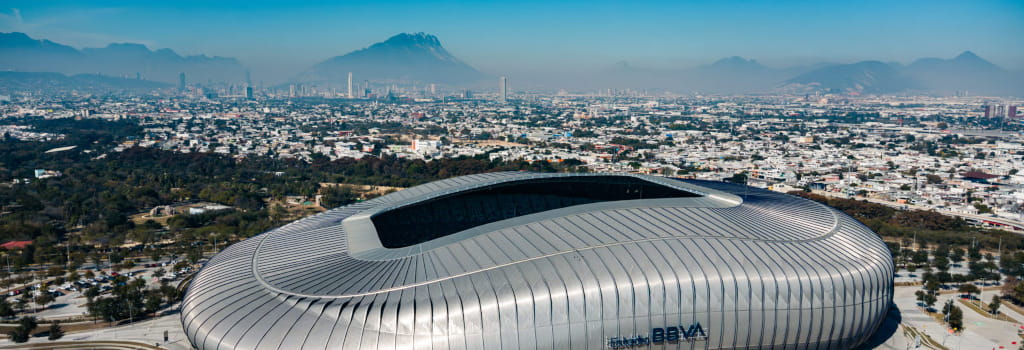
One of those memories in 2026 might not come from a player at all. It could come from Estadio Monterrey, the spectacular venue sitting beneath the towering slopes of Cerro de la Silla in northern Mexico. With its dramatic mountain backdrop, it could be the most picturesque stadium at the tournament and the one that attracts the most attention.
That might sound surprising when you look at the fixtures. Monterrey's group-stage schedule includes Tunisia versus Sweden, Tunisia versus Japan, and South Korea versus South Africa, hardly the sort of matches that had supporters circling dates when the draw was made.
Of course, the exception may come in the Round of 32. Monterrey will host the winners of Group F against the runners-up from Group C, a tie that could see the Netherlands face Morocco. Anyone betting on football and glancing at the World Cup outright markets will notice the Dutch sitting at around 22/1 to go all the way. At the same time, Morocco's remarkable run to the semi-finals in Qatar remains fresh in the memory, giving this potential tie all the ingredients of a modern World Cup classic.
The greatest show in the world is ready. Are you?#FIFAWorldCup pic.twitter.com/ISxLhuLUkm
— FIFA World Cup (@FIFAWorldCup) April 1, 2026
Even if it never materialises, it is difficult to imagine any game in Monterrey being forgettable.
What makes Monterrey different is that the backdrop is not an accident. The stadium was deliberately designed to frame Cerro de la Silla, the mountain that dominates the city's skyline. From certain angles inside the ground, the mountain appears to rise directly behind the stands, creating a view unlike anything supporters will see elsewhere at the tournament.
The stadium itself is no shrinking violet. Opened in 2015 at a cost of around $200 million, it is home to Mexican giants Monterrey and is known locally as the "Steel Giant" because of its futuristic aluminium and steel exterior. Designed by Populous, the firm behind Wembley and the Tottenham Hotspur Stadium, it was built with major events in mind and will hold more than 50,000 supporters during the World Cup.
A look at Monterrey Stadium ahead of the 2026 FIFA World Cuppic.twitter.com/JtjLgjbIvP
— FOX Soccer (@FOXSoccer) June 1, 2026
Yet it is the setting rather than the architecture that makes this venue stand out. Most World Cup stadiums are remembered for what happened inside them. Monterrey has a chance to be remembered for what sits beyond its walls. Television directors will have little choice but to linger on the mountain whenever play stops. This will be especially true during evening kick-offs when the fading light falls across the Sierra Madre Oriental.
There is also something fitting about one of the tournament's most modern stadiums being rooted so strongly in its surroundings. While many venues could be picked up and dropped into another city without looking out of place, Monterrey feels inseparable from its landscape. Remove Cerro de la Silla, and it becomes a very good stadium. Keep it there, and it becomes one of the most distinctive football venues on the planet.
Perhaps that is why the stadium may leave such a lasting impression, regardless of who reaches the knockout stages. Indeed, long after the final whistle blows, many supporters may remember the view as vividly as the football itself.
World Cups have always been about more than results. Italia '90 had its anthem. Germany 2006 had its summer carnival atmosphere. South Africa 2010 had its unmistakable soundtrack that divided opinion. Monterrey may yet give 2026 its defining postcard, a stadium framed by mountains and a backdrop that feels almost too dramatic to be real.
The 91 biggest football stadiums in Europe. From Manchester to Munich, Villa Park to Valencia - each one with a capacity over 40,000

Tony Incenzo has been to over 2,000 football grounds - is he the world's barmiest football fan? Read about his love for Non-League football and groundhopping obsession, including watching a match in prison!

My daughter's first ever football match - Orlando City v Atlanta United, August 2019. Written for Izzy to read when she gets old enough. Vamos Orlando
An in-depth look at the biggest football attendances ever recorded, from the 1950 World Cup to pre-season friendlies in the States and the Scottish ground with dozens of 100,000+ attendances