 Football Ground Map
Football Ground Map
Football Ground Map


The 2026 World Cup Finals are getting ever closer, as continental qualification nears completion. With the United States, Canada and Mexico sharing hosting duties, there will be a total of sixteen stadiums welcoming fans from around the globe, the most since the 2002 World Cup Finals, which was previously held in Japan/South Korea.
We already know that England and Scotland have qualified from the “home” nations, while Wales, Northern Ireland and the Republic of Ireland all face play-offs to book their flights to North America next March.
For those that will be looking to bet on the 2026 World Cup, venue information could be hugely important, with temperatures likely to affect teams as was seen at the Club World Cup. For European nations this is quite significant, as only two nations have won a FIFA World Cup outside of their continent, Spain doing so in South Africa back in 2010 and Germany following in 2014, when hosted by Brazil.
So, let Del Pugh from Bookies Bonuses offer a quick look guide to the World Cup stadia and some key weather information to consider across the 104 matches that will take place, as the build up to the world's biggest sporting event begins.
Canada's two stadiums host thirteen matches in total, including a Round of 16 contest and it's clear to see from the average high temperatures for June/July, that the majority of home and European nations will be quite happy to be drawn in Group G or Group L, which has several matches in the Land Of Maple.
| Stadium | Capacity | Year Built | Average HIgh Temp. | Games |
|---|---|---|---|---|
| BC Place, Vancouver | 54,000 | 1983 | 20-23°C | 7 |
| Toronto Stadium | 45,000 | 2007 | 25-26°C | 6 |
Mexico plays host to fifteen matches, including the opener at the Azteca Stadium in Mexico City. Monterrey will be the place most nations will want to avoid, especially during the day, where searing heat will be a massive issue for players physically.
| Stadium | Capacity | Year Built | Average High Temp. | Games |
|---|---|---|---|---|
| Estadio Azteca, Mexico City | 83,000 | 1966 | 25-26°C | 5 |
| Estadio Guadalajara | 45,000 | 2007 | 27-30°C | 6 |
| Estadio Monterrey | 53,500 | 2015 | 35-36°C | 4 |
The United States takes on the bulk of matches at the 2026 World Cup Finals, including the final itself at the MetLife Stadium, known as the New York/New Jersey Stadium due to restrictions on sponsorship names by FIFA.
Teams will hope to be drawn in Groups B, D or G to minimise heat issues and potential travel headaches, while Group F features games in Dallas, Houston and Kansas City, almost guaranteeing 30°C for every game.
| Stadium | Capacity | Year Built | Average High Temp. | Games |
|---|---|---|---|---|
| Atlanta Stadium | 75,000 | 2017 | 30-32°C | 8 |
| Boston Stadium | 65,000 | 2002 | 24-28°C | 7 |
| Dallas Stadium | 94,000 | 2009 | 34-36°C | 9 |
| Houston Stadium | 72,000 | 2002 | 31-33°C | 7 |
| Kansas City Stadium | 73,000 | 1972 | 29-32°C | 6 |
| Los Angeles Stadium | 70,000 | 2020 | 26-29°C | 8 |
| Miami Stadium | 65,000 | 1987 | 29-30°C | 7 |
| NY/NJ Stadium | 82,500 | 2010 | 27-30°C | 8* |
| Philadelphia Stadium | 69,000 | 2003 | 29-32°C | 6 |
| San Francisco Bay Stadium | 71,000 | 2014 | 19-20°C | 6 |
| Seattle Stadium | 69,000 | 2002 | 19-22°C | 6 |
As mentioned at the beginning, European nations have rarely performed well outside of the continent, winning just two of the previous twenty-two editions, compared to six by South American nations, but will that change in 2026?
Spain, England and France lead the betting in terms of outright winners, but as we saw in Qatar back in 2022, conditions can be a factor, with the likes of Saudi Arabia's win over Argentina, Australia beating Denmark and Morocco's run to the semi-final offering potential evidence to back up the claim, although it would be unfair to not take into consideration the quality of the teams themselves.
It will be a tough ask especially with South American and the African sides looking strong, and as much as I don't see England going all the way, the likes of a Spain or France may well have enough to get the job done in 2026.
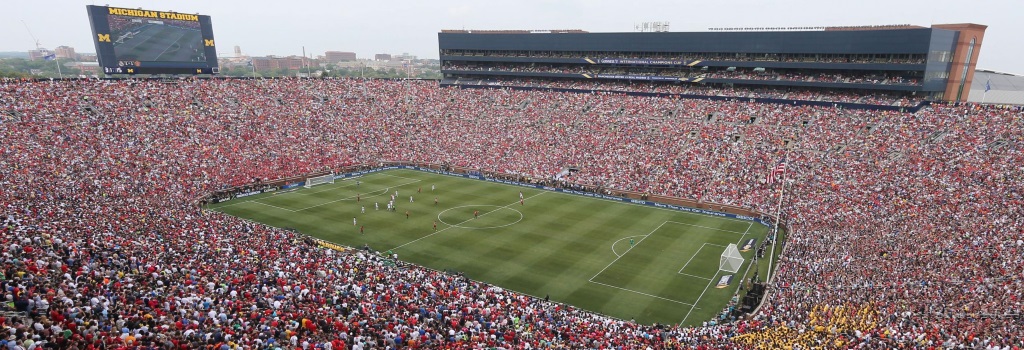
An in-depth look at the biggest football attendances ever recorded, from the 1950 World Cup to pre-season friendlies in the States and the Scottish ground with dozens of 100,000+ attendances
The 91 biggest football stadiums in Europe. From Manchester to Munich, Villa Park to Valencia - each one with a capacity over 40,000

23 interesting things to do to pass the time until the football season restarts
All good things have to come to an end, and the same unfortunately has to be said for football stadiums too. This article looks at the grounds which are soon to host their last match, the stadiums whose days are numbered and where fans will be watching their football from next.